I built the compliance system that closed million-dollar aerospace contracts
Dealbreaker to differentiator. NC tracking became the feature that enabled Manufacturo to close aerospace and defense contracts, moving from a gap customers cited as a dealbreaker to a differentiator in competitive evaluations.
Project Details
- COMPANY
- Manufacturo
- ROLE
- Product Designer
- LENGTH
- 5 months
- YEAR
- 2023
About Manufacturo
Manufacturo is a SaaS software platform built by former SpaceX employees serving various manufacturing organizations in complex and regulated industries.
Without AS9100-compliant nonconformance tracking, you can’t sell to aerospace.
Compliance gap
The existing system couldn’t generate the documentation AS9100 auditors require. AS9100 is the quality management standard that governs aerospace manufacturing.
Workflow gap
There was no structured way to move a defect from discovery through disposition to resolution with multiple stakeholders involved.
Visibility gap
Without trend analysis, quality teams couldn’t identify recurring defects. They were reacting to the same problems on repeat.
The stakes
Manufacturo was positioned to compete for this market. The platform was capable, but every serious prospect in aerospace and defense hit the same wall. No compliant nonconformance tracking meant no deal. Manufacturo was looking at millions of dollars in aerospace contracts blocked by one missing feature.
What they had vs. what aerospace actually requires.
A lightweight nonconformance tracker designed for high volume / identical units with simple defect routing (e.g., pass or fail).
A complete chain of accountability: document the defect, create a disposition to fix the issue, evaluate the plan, stamp approval, execute the fix, verify the work, and track for trends. Multiple steps, multiple stakeholders, full audit trail.
We like your manufacturing software, but you’re missing nonconformance tracking. That’s a dealbreaker.
Speed vs. documentation depth
The quality engineer needs to move fast under pressure. The compliance officer needs a complete record that may not be needed for months. These are in direct conflict. I solved it by designing documentation to happen as a byproduct of the workflow itself. The quality engineer does their job. The audit trail builds itself.
Changing the mental model
Part broken? Tag it, set it aside, move on.
Full chain of accountability — from discovery through resolution.
Early conversations made it clear that documentation alone wouldn’t satisfy AS9100 auditors, and workflow alone wouldn’t close deals. I built the case that three components had to ship together:
- Workflow integration — technicians should be able to automatically pause work when a defect was found
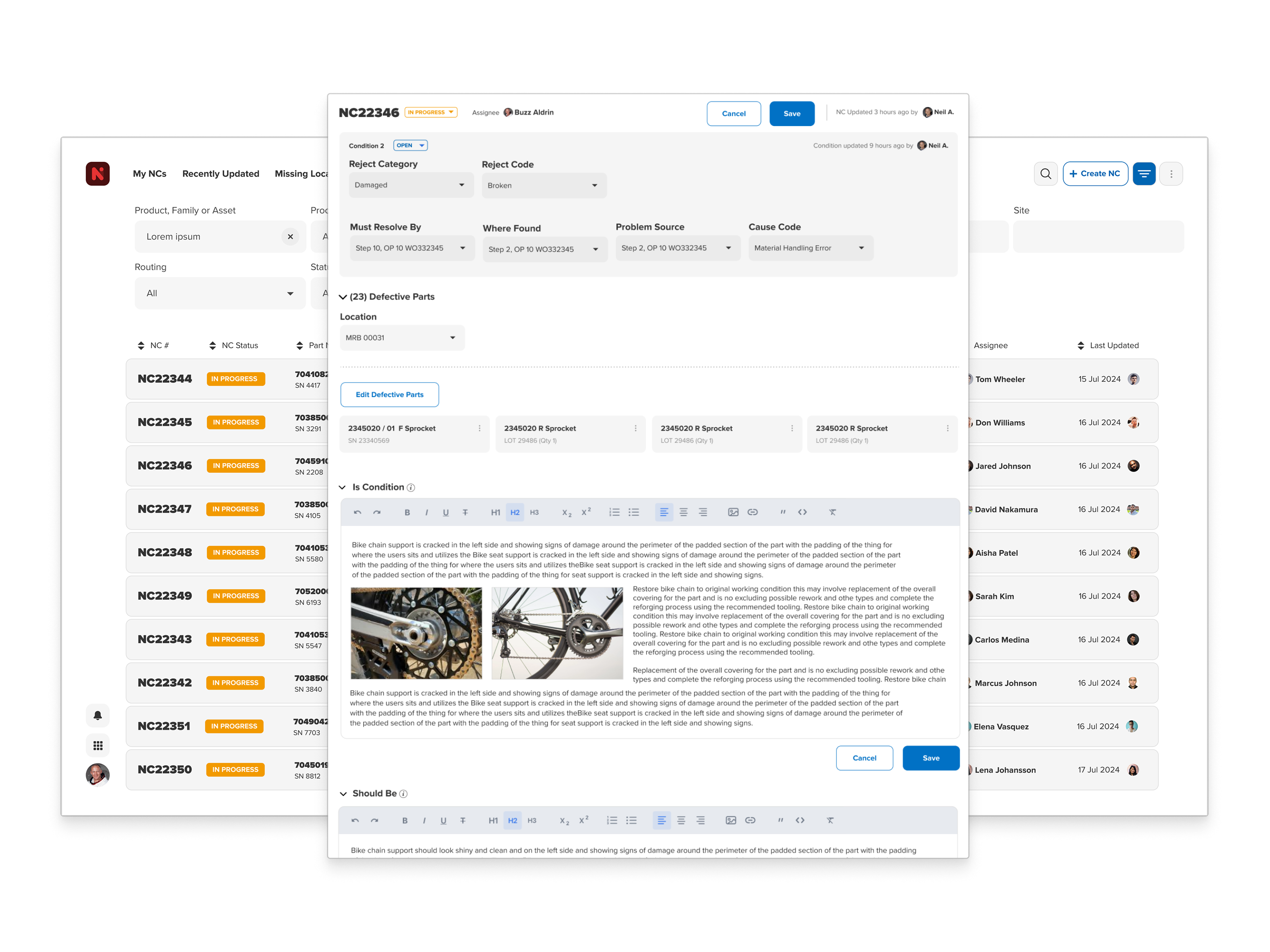
- Defect logging — a wizard would help capture all critical information and group similar defects together to enable future trend analysis
- Defect resolution workflow — solving a defect is called dispositioning. The discrete steps (e.g., planning, approval, executing, and verification) require a clean, managed workflow
All three pieces had to ship together. Solving two of three wasn’t a partial win. It was a failed product. I got leadership aligned on full scope before a single wireframe existed.
The schema optimized for fast defect entry is not the schema that supports trend analysis six months later. Research showed that most teams discover this after the fact when they try to add corrective action reporting after collecting mounds of data. I designed the data model to support all three layers from day one, even though trend analysis wasn’t on the immediate roadmap. When corrective action was greenlit, it shipped in weeks instead of months because the architecture was already there.
Under production pressure, people don’t work in order. A linear chain gets routed around, and an audit trail full of workarounds is worse than no audit trail. The data model I designed allowed parallel disposition tracks so multiple defects from the same inspection could each progress independently. This enabled production to keep moving while keeping the audit trail clean.
Defects and issues impact the manufacturing schedule. Automatically pausing the work order helps the technician on the floor but risks to schedule need to be surfaced to the product planners. I added visual cues to ensure that potential changes to timing are surfaced appropriately, and to track resolved issues in the final assembly.
Results.
Major sales closed after feature release
The release of the nonconformance feature unlocked sales to two major customers that were previously blocked by the lack of compliance support. These two key sales led to the best quarter in company history, and would not have been possible without nonconformance reporting.
System worked under pressure
Documentation time dropped from a ~40 minute effort to a ~10 minute guided wizard. Quality engineers stopped routing around the system because it was faster to use it than to work outside it.
Audit trail built itself
Compliance officers got audit-ready reports generated automatically as a byproduct of normal workflow. Zero extra work. When auditors asked for Q2 nonconformance documentation, the answer was a report, not a two-day email dig.
Dealbreaker to differentiator
NC tracking moved from a gap customers cited as a dealbreaker to a feature mentioned positively in competitive evaluations.